
For decades, Germany was the undisputed economic engine of Europe. The formula was simple, predictable, and wildly successful: elite engineering, a powerhouse Mittelstand, cheap imported energy, coupled with booming global export markets.
But look closely at the numbers over the last few years, a decade. A cold reality check hits hard – Germany’s industrial model is facing a structural crisis. While the US relies on massive domestic energy and high-tech reshoring subsidies, France leverages domestic nuclear stability, Germany has flatlined. The problem isn’t a lack of talent or ambition. The problem is German ultraconservative narrative governing the economy, currently trapped in a web of own institutional caution, which is hollowing out competitive edge from the inside out.
I think a vast majority of academic economists and business leaders would agree the Four Pillars of German Economic Inertia:
- An Antiquated Pension System: While countries like the US, Sweden, the Netherlands, Switzerland, UK, etc. back their citizens’ futures with robust stock market allocations, the German pension system remains rigidly risk-averse, missing out on decades of compounding global growth.
- The Energy Vacuum: The absolute ban on nuclear power paired with the abrupt cutoff of cheap pipeline gas has left German energy-intensive industries (chemicals, steel, manufacturing) exposed to crushing structural costs.
- A Bureaucratic Fortification: Obtaining a basic permit for infrastructure, digital deployment, or factory expansion in Germany requires a heroic fight against a dense, paper-heavy bureaucratic system (btw. Slovenia tries to compete fiercely with the Germans…). Innovation moves at the speed of software; German and Slovene permits move at the speed of a filing cabinet.
- The Self-Imposed Deficit Ceiling: The constitutionally enshrined (Schuldenbremse) keeps German public debt remarkably low (approx.. 64% of GDP) compared to neighbors like France (approx.. 115%) or the US (~123%), or the EMU average (approx. 88%). But this fiscal purity comes at a devastating cost: a massive, multi-billion-euro infrastructure deficit in German roads, rail networks, and digital grids.
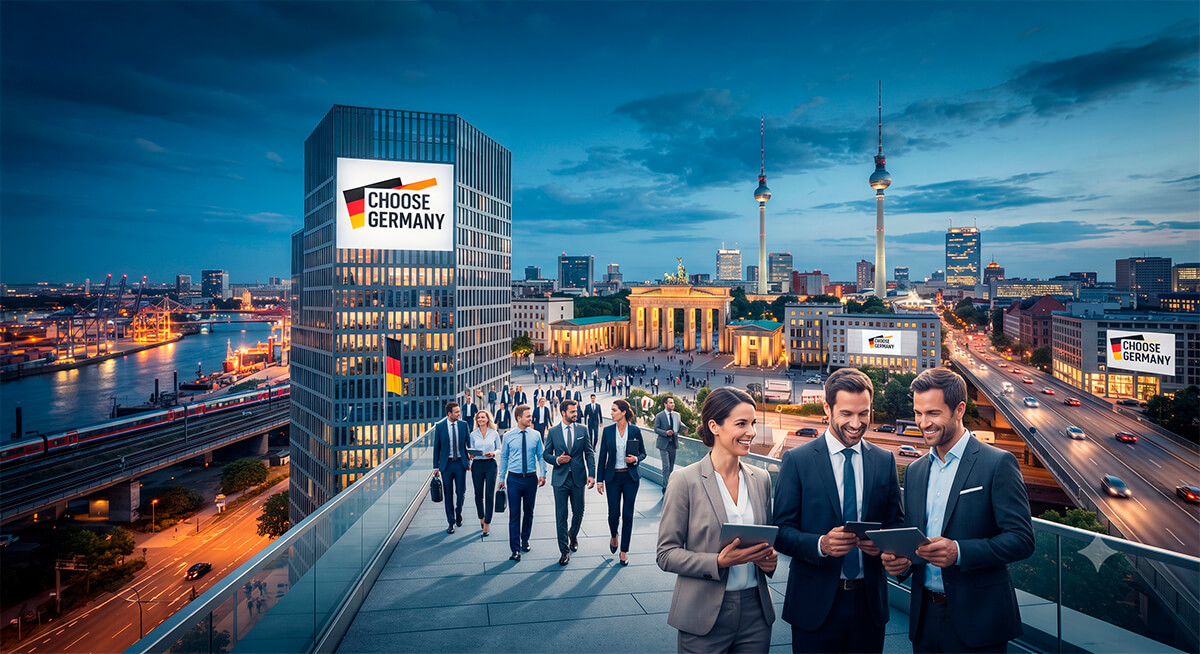
The Turning Point: Borrowing a Page from the French Playbook
Chancellor Merz has made an announcement of an exclusive, targeted investment summit. Heavily echoing Emmanuel Macron’s highly successful “Choose France” initiative might present a critical crossroads. This cannot just be another high-level political photo-op. It must be a fundamental psychological shift. If public borrowing is legally constrained by the abovementioned debt brake, the solution is staring us right in the face: Germany must unlock and attract substantial amounts of private capital.
To turn an investment summit into a genuine economic renaissance, the government has to execute some bold structural moves:
- Liberalize Capital Allocations of Pensionskassen: German needs to structurally untie the hands of German pension funds and institutional investors, allowing them to legally allocate a significant portion of capital into equities, venture capital, and domestic infrastructure, where productivity and new technologies can thrive.
- Slash the Red Tape: The summit must launch a radical, fast-track liberalization of the permit process. If a high-tech breakthrough or clean-energy project takes years just to clear the local registry, the capital will simply leave to fund projects in Asia or in the rest of Europe at best.
- Get into grips with energy subordination. In today’s world it is impossible to wrap someone’s head around the lack of own energy that constitutes the main energy pillar (btw. renewables can’t check this box alone).
- Rewrite the Governing Narrative: Germany must shift from an economy focused on managing risk and preserving the past to one focused on enabling the future.
The Bottom Line is: Germany does not have a wealth problem; it has a mobility-of-wealth problem. The upcoming investment summit is the perfect opportunity to shed the ultraconservative economic armor. By matching global private capital with Germany’s world-class engineering talent, Germany can perhaps unlock the next wave of technological breakthroughs and in the coming decade reestablish its economic might. Unless Germany’s governance stops managing the decline and starts funding the comeback, insolvency wave will persist and some companies might make headlines about yet another record of job closures, similar to Volkswagen’s. And workers might simply land on government funds as new job openings will simply be non-existing.
German economy will perhaps restructure on a high note, but some more bad news will follow. Similarly to a company that has to manage a painful transition (financial distress or even get court protection), many external processes are going on. Buyers and suppliers for example diversify and that brings yet another layer of difficulties. Things will never be the same again, but hopefully Germans will be eventually able to shift into a higher gear (and become somewhat less conservative).